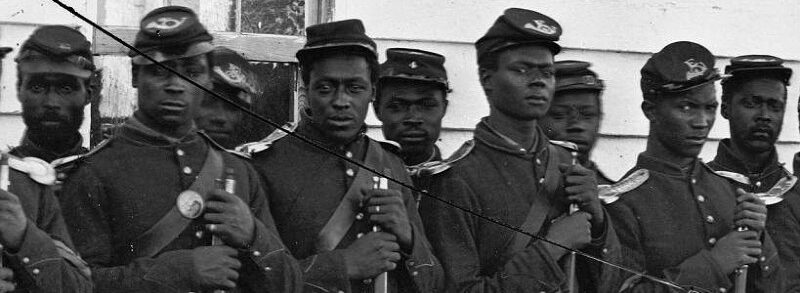
Revolutionary Possibility and Violent Backlash, 1865–1877
When the Civil War ended in April 1865, the United States faced a set of questions it had never answered before. How would a country built on slavery reconstruct itself once slavery was gone? What did freedom mean for nearly four million newly freed people? Who counted as a citizen, and what rights did citizenship confer? For roughly twelve years, the federal government, Black Americans, former Confederates, and Northern reformers fought over the answers. As W.E.B. Du Bois argued in Black Reconstruction in America, this was not simply a period of political adjustment — it was “the finest effort to achieve democracy for the working millions which this world had ever seen,” a genuine revolution in which formerly enslaved people built schools, hospitals, and democratic governments in the ruins of the plantation system (Du Bois, 1935). By 1877, that revolution had been deliberately and violently crushed — but the constitutional changes it produced shaped American life for the next century and a half.
Forty Acres and a Mule: What Freedom Meant
In January 1865, thousands of formerly enslaved people gathered outside Savannah, Georgia, which Union General William T. Sherman had recently captured. Secretary of War Edwin Stanton and Sherman met with twenty Black leaders, most of them ministers, to ask a direct question: what did freedom mean to them? The group chose Reverend Garrison Frazier as their spokesperson.
Frazier’s answer was concise: the best way to take care of themselves, he said, was to have land, to turn it and till it by their own labor (Berlin et al., 1992). This was not a modest request. It was a demand for the material basis of freedom — the recognition that legal liberty without economic independence was not freedom at all but a new form of dependency. As Du Bois documented in Black Reconstruction, the formerly enslaved had “but one clear economic ideal”: the redistribution of the great plantations whose soil they had built with their bodies (Du Bois, 1935). Every other right — political, social, legal — depended on this foundation. Without land, freed people would be forced back into someone else’s fields on someone else’s terms.
Four days after the meeting, Sherman issued Special Field Order No. 15, setting aside roughly 400,000 acres of confiscated Confederate land along the South Carolina and Georgia coast for Black families in forty-acre plots, along with some broken-down army mules (Foner, 2014). The phrase “forty acres and a mule” spread through Black communities across the South like wildfire. For a brief moment, the federal government appeared to be committing itself to the radical idea that land — not just legal freedom — was owed to people who had been enslaved. Du Bois argued that this was not charity but justice: freed people had earned those lands through generations of uncompensated labor, and their claim was more legitimate than that of the planters who had stolen their work (Du Bois, 1935).
The Freedmen’s Bureau
Congress established the Bureau of Refugees, Freedmen, and Abandoned Lands — the Freedmen’s Bureau — in March 1865. The Bureau was tasked with providing food, clothing, and medical aid to freedpeople and Southern refugees; establishing schools; supervising labor contracts; and managing confiscated and abandoned land (Foner, 2014). It was the closest thing the United States had ever built to a federal social welfare agency. Black communities across the South embraced it: freedpeople founded schools and demanded education with an urgency that stunned white observers, understanding that literacy was itself a form of power that slavery had deliberately withheld. For many freedpeople, the Bureau was the first government agency that seemed to see them as citizens. For many white Southerners, it was an intolerable intrusion.
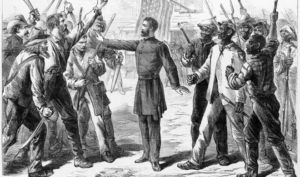
Alfred R. Waud, “The Freedmen’s Bureau” (Harper’s Weekly, 1868). A Bureau agent stands between armed groups of white and Black men. Library of Congress; public domain.
Lincoln’s Death and the Rise of Andrew Johnson
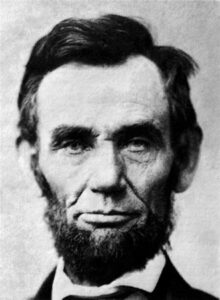
Abraham Lincoln, photographed in 1863. Library of Congress; public domain.
On April 14, 1865, five days after Lee’s surrender at Appomattox, John Wilkes Booth shot Lincoln at Ford’s Theater. Lincoln died the next morning. The presidency passed to Vice President Andrew Johnson, a Tennessee Democrat Lincoln had added to the ticket in 1864 to signal national unity.
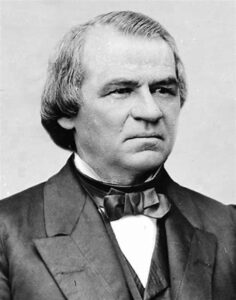
President Andrew Johnson. Library of Congress; public domain.
Johnson had grown up poor and resented the Southern planter aristocracy, but he was also, in the words of historian Eric Foner, an unapologetic racist who believed that free Black Americans must remain subordinate to whites (Foner, 2014). When Frederick Douglass met him, Johnson gave him what Douglass called a “death stare.” Douglass turned to a friend and said that whatever else this man might be, he was not a friend of their race (Blight, 2018).
Johnson’s Reconstruction plan required former Confederate states only to void their secession ordinances, reject their Confederate debts, and ratify the Thirteenth Amendment. On everything else, the states could do what they wanted. He pardoned most former Confederates, including wealthy planters, and went on to veto more bills than any president before him — many of them aimed at protecting freedpeople. The confrontation pushed a frustrated Congress toward increasingly aggressive action (Foner, 2014).
A Case Study: Tunis Campbell and St. Catherines Island
The stakes of Johnson’s policies are clearest in small-scale cases. Tunis Campbell, a Black New Jersey minister and educator who had worked with Frederick Douglass, was named superintendent of several Union-occupied Georgia sea islands in 1865. On St. Catherines Island, he and the resident freedpeople organized their own government and militia, rebuilt plantation infrastructure, and established schools in which he and his wife taught roughly 1,000 students (Duncan, 1986).
In 1867, Jacob Waldburg, the former planter who had owned St. Catherines, demanded that Campbell leave. The Black islanders responded that the island was now theirs. President Johnson ordered all such land returned to its former owners, reversing Sherman’s Field Order No. 15 and every similar arrangement across the occupied South (Foner, 2014). The head of the Freedmen’s Bureau was sent, community by community, to tell freedpeople that the promise of land was not going to be kept. This was not a political miscalculation. It was, as Du Bois would later argue, the first act of the counter-revolution of property — the organized effort of the planter class and its allies to take back what the war had cost them (Du Bois, 1935). Black Union soldiers were sent in to negotiate the surrender of the island. Agricultural reform — the most radical promise of Reconstruction — was effectively dead.
Campbell himself did not give up. He later bought 1,250 acres and organized a cooperative of Black landowners, rose to become a vice president of the Georgia Republican Party, and served as a state senator pushing for equal education, integrated juries, abolition of debtors’ prisons, and voting rights. White terrorists burned his home and tried to poison him; he organized a 300-person Black militia in response. In 1876 he was convicted of “malfeasance in office” on charges many historians consider politically motivated, and served a year in a convict labor camp (Duncan, 1986). His story is this chapter’s story in miniature: revolutionary possibility, violent backlash, and resistance that refused to fully stop.
Radical Republicans and the Thirteenth Amendment
With Southern Democrats out of Congress, Republicans held large majorities. Senator Charles Sumner had proposed language drawn from the French Declaration of the Rights of Man: all persons are equal before the law, so that no person can hold another as a slave. That universalist language did not survive the compromise process. The final version of the Thirteenth Amendment, ratified in December 1865, reads: “Neither slavery nor involuntary servitude, except as a punishment for crime whereof the party shall have been duly convicted, shall exist within the United States.”
The shift matters enormously. Declaring all persons equal before the law would have made racial equality itself constitutional. Banning slavery “except as a punishment for crime” left open a door that Southern states walked through almost immediately (Blackmon, 2008). This was not an oversight. As Paul Ortiz argues, the exception clause was the mechanism through which racial capitalism reconstituted itself after emancipation — transforming the legal question from “can this person be enslaved?” to “has this person committed a crime?” — a question whose answer white-controlled courts and police forces could manufacture on demand (Ortiz, 2018).
Black Codes
Within months of the Thirteenth Amendment’s ratification, Southern states began passing Black Codes — laws designed to reproduce slavery without using the word. Under these codes, Black men could not serve on juries or in state militias. Black testimony against white people was not accepted in court. Orphaned Black children were “apprenticed” — often back to their former enslavers (Foner, 2014).
The most important codes were vagrancy laws. Mississippi’s required every freedman to carry papers proving he had employment. If he could not produce them, he could be arrested and fined. If he could not pay the fine, the sheriff was authorized to hire him out to anyone willing to pay it. In other words, the Black Codes used the Thirteenth Amendment’s punishment-for-crime exception to re-create forced, unpaid Black labor. Douglas Blackmon has called this system “slavery by another name”: the re-enslavement of Black Americans through the machinery of criminal law, a system that persisted not for years but for decades, well into the twentieth century (Blackmon, 2008).
Congressional Republicans responded with the Civil Rights Act of 1866, which for the first time constitutionally defined all American-born residents (except Native Americans) as citizens with equal rights. Johnson vetoed it. Congress overrode him — the first time in American history a presidential veto of a major piece of legislation was overridden (Foner, 2014).
The Fourteenth and Fifteenth Amendments
Congress also required ratification of the Fourteenth Amendment as a condition for former Confederate states to rejoin the Union, and divided the South into five military districts under army supervision (Foner, 2014).
The Fourteenth Amendment (1868) did three things that reshaped American life: it overturned the 1857 Dred Scott decision by granting citizenship to all persons born or naturalized in the United States, which made formerly enslaved people citizens and also established birthright citizenship for the children of immigrants; it prohibited any state from denying “equal protection of the laws” or depriving any person of “life, liberty, or property, without due process of law”; and it barred former Confederate officials from holding office unless Congress granted amnesty. The “equal protection” clause would be tested and narrowed in Plessy v. Ferguson (1896), which held that racially segregated facilities did not violate it, then broadened again in Brown v. Board of Education (1954), which ruled that separate was inherently unequal.
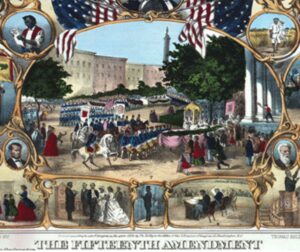
Thomas Kelly, celebratory print of the Fifteenth Amendment, 1870. Library of Congress; public domain.
The Fifteenth Amendment (1870) barred states from denying the vote on account of race, color, or previous condition of servitude. It was driven partly by conviction and partly by Republican self-interest — the 1868 election had been close, and adding loyal Black voters seemed the best way to keep the former Confederate states from handing Congress to Democrats (Foner, 2014).
The Fifteenth Amendment also split the women’s suffrage movement. Many leading suffragists — including Elizabeth Cady Stanton and Susan B. Anthony — had been abolitionists, and they were bitter that the amendment enfranchised Black men but not women of any race. Frederick Douglass responded that for Black men in the South, the vote was a question of life and death. Frances Harper, a Black suffragist, pushed white women to recognize their own privilege (Dudden, 2011). Women did not gain the federal right to vote until 1920 — and in practice, Black women in the South were largely excluded until 1965.
Under the new legal framework, more than 2,000 Black men held elected office during Reconstruction, including two U.S. senators from Mississippi, fourteen members of the House, and P. B. S. Pinchback, who briefly served as governor of Louisiana (Foner, 2014). Du Bois documented the legislative achievements of these governments in extraordinary detail: they built the South’s first public school systems, established hospitals and orphanages, rewrote state constitutions to remove property requirements for voting, and created the institutional infrastructure of a democratic society from scratch (Du Bois, 1935).
White Terrorism
Constitutional amendments did not stop the violence — in many places, they intensified it. The Ku Klux Klan, founded in Pulaski, Tennessee in 1866, spread to nearly every state of the former Confederacy by 1868 and functioned, as Foner documents, as the military arm of the Democratic Party (Foner, 2014). Klan members were often drawn from the Southern upper class. Their targets were Black officeholders, Black voters, Black landowners, Black teachers, and white Republicans.
The scale of the violence is hard to comprehend. In Panola County, Mississippi, twenty-four Klan-style murders occurred between August 1870 and December 1872. In nearby Lafayette County, Klansmen drowned thirty Black Mississippians in a single mass murder. Massacres in Memphis (1866), New Orleans (1866), Colfax (1873), and Vicksburg (1874) killed dozens to hundreds of Black residents at a time (Lemann, 2006).
Ida B. Wells — a Black journalist who grew up in the South and built her career documenting what the mainstream white press refused to name — was among the first to analyze lynching not as mob disorder but as a deliberate political and economic weapon. In Southern Horrors: Lynch Law in All Its Phases (1892) and A Red Record (1895), she documented that the rape accusation used to justify most lynchings was almost always false — a manufactured pretext for terror whose real purpose was to drive Black men from economic competition, destroy Black political power, and maintain white supremacy by fear (Wells, 1892; Wells, 1895). Her analysis preceded and shaped every subsequent scholarly understanding of Reconstruction-era violence: lynching was not the product of uncontrollable passions but of calculated strategic interest.
In response, Congress passed the Enforcement Acts of 1870 and 1871, which criminalized the deprivation of civil rights and authorized the president to use federal troops and even suspend habeas corpus to break up the Klan. For a few years, federal prosecutions did suppress Klan activity. But the political will to sustain that enforcement was already fading.
The Depression of 1873 and the Counter-Revolution of Property
In September 1873, a major investment bank failed and triggered a six-year depression. Northern workers lost jobs; Northern taxpayers lost patience with paying for federal troops in the South. Racist commentary that had always existed in the North now had new political traction: commentators asked why “ignorant former slaves” were holding office while the “best men” of the South were excluded (Foner, 2014).
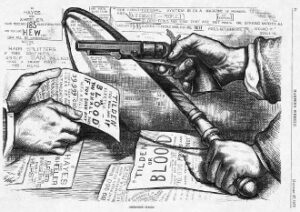
Thomas Nast, “Compromise — Indeed!” Harper’s Weekly, January 27, 1877. The cartoon shows the threat of violence underlying the disputed 1876 election. Library of Congress; public domain.
Du Bois named what followed with precision: not a failure of Reconstruction but a deliberate counter-revolution of property. The planter class, Northern industrialists, and the Democratic Party united to destroy the political power that freed people had built. The goal was not simply to restore white Democratic rule in the South; it was to ensure that the freed people’s labor remained cheap and controlled — to reconstitute, by law and violence, the conditions of exploitation that slavery had provided (Du Bois, 1935). As Paul Ortiz argues, this counter-revolution had a racial capitalist logic: the extraction of Black labor required the destruction of Black political power, and the two projects were inseparable (Ortiz, 2018).
The 1876 presidential election between Republican Rutherford B. Hayes and Democrat Samuel Tilden produced disputed results in South Carolina, Louisiana, and Florida, with widespread fraud and voter intimidation by Klan-linked groups. A fifteen-person federal commission resolved the dispute along strict party lines, handing the presidency to Hayes. In what became known as the Compromise of 1877, Democrats accepted Hayes’s election in exchange for the withdrawal of remaining federal troops from the South (Foner, 2014).
Reconstruction was over. Over the next two to three decades, Southern Democrats systematically stripped Black Americans of the rights they had won, replacing them with poll taxes, literacy tests, convict leasing, sharecropping debt, and legalized segregation. The Thirteenth, Fourteenth, and Fifteenth Amendments remained on the books, but as Wells had shown and Du Bois confirmed, the law is only as powerful as the political will to enforce it — and that will had been bought off at Hayes’s election.
Sharecropping and the Southern Economy
With land reform dead, most freedpeople had no way to farm except on land they did not own. Sharecropping — in which a family farmed a plot in exchange for a share of the crop — became the dominant labor system of the postwar South. In theory, it was a step up from slavery. In practice, landowners controlled supplies, credit, and the scales; sharecroppers were often left in permanent debt, legally bound to stay on the land until their accounts were settled.
Combined with convict leasing, vagrancy laws, and debt peonage, sharecropping produced exactly what Du Bois predicted the failure of land reform would produce: a rural Black working class whose labor remained, in most material respects, unfree (Du Bois, 1935; Blackmon, 2008). Blackmon documents how this system was not hidden — it was explicit, publicized, and profitable, with Black convict laborers leased to coal mines, lumber camps, brick yards, and railroads by state governments that collected the revenue. The “slavery by another name” that Blackmon describes persisted not until the end of Reconstruction but until World War II (Blackmon, 2008).
The southern economy remained impoverished and dependent on coerced Black labor until at least the New Deal of the 1930s — and in some respects until the civil rights movement forced federal enforcement of the amendments that Reconstruction had written but the counter-revolution had rendered dead letters.
Conclusion
Reconstruction was, as Du Bois argued, the most ambitious experiment in interracial democracy the world had yet seen — and it was destroyed by a coordinated counter-revolution of property, terror, and political deal-making. The revolution that freed people built — schools, legislatures, constitutions, cooperatives, militia companies — was real. The forces that destroyed it were also real: the Klan, the planter class, Northern capital, a Republican Party exhausted by war and increasingly interested in industrialization rather than racial justice, and a federal state unwilling to pay the cost of actually enforcing the amendments it had ratified.
What Ida B. Wells understood, writing from inside the terror, was that this was not a tragedy of good intentions overwhelmed by violent circumstances. It was a system operating as designed. Lynching was not mob disorder; it was governance — the enforcement of a racial and economic order by extralegal means when legal means seemed insufficient. The failure of Reconstruction was the success of the counter-revolution, and the questions that Reconstruction raised — about land, labor, citizenship, and the meaning of freedom — were not resolved. They were deferred, sometimes for decades, sometimes for generations, until the next organized struggle forced them back open (Du Bois, 1935; Wells, 1895; Ortiz, 2018).
Bibliography
Berlin, Ira, Barbara J. Fields, Steven F. Miller, Joseph P. Reidy, and Leslie S. Rowland. Free at Last: A Documentary History of Slavery, Freedom, and the Civil War. New York: The New Press, 1992.
Blackmon, Douglas A. Slavery by Another Name: The Re-Enslavement of Black Americans from the Civil War to World War II. New York: Doubleday, 2008.
Blight, David W. Frederick Douglass: Prophet of Freedom. New York: Simon & Schuster, 2018.
Du Bois, W.E.B. Black Reconstruction in America: An Essay Toward a History of the Part Which Black Folk Played in the Attempt to Reconstruct Democracy in America, 1860–1880. New York: Harcourt, Brace and Company, 1935.
Dudden, Faye E. Fighting Chance: The Struggle Over Woman Suffrage and Black Suffrage in Reconstruction America. New York: Oxford University Press, 2011.
Duncan, Russell. Freedom’s Shore: Tunis Campbell and the Georgia Freedmen. Athens: University of Georgia Press, 1986.
Foner, Eric. Reconstruction: America’s Unfinished Revolution, 1863–1877. Updated ed. New York: Harper Perennial, 2014.
Lemann, Nicholas. Redemption: The Last Battle of the Civil War. New York: Farrar, Straus and Giroux, 2006.
Ortiz, Paul. An African American and Latinx History of the United States. Boston: Beacon Press, 2018.
Wells, Ida B. Southern Horrors: Lynch Law in All Its Phases. New York: New York Age Print, 1892.
Wells, Ida B. A Red Record: Tabulated Statistics and Alleged Causes of Lynchings in the United States, 1892–1893–1894. Chicago: Donohue & Henneberry, 1895.

This entry is licensed under a Creative Commons Attribution-NonCommercial-ShareAlike 4.0 International license.

