A Continent Reimagined as Empty
American textbooks have often presented the late nineteenth century as a story of national progress — railroads stitching the continent together, homesteaders building farms, the Civil War giving way to industrial modernity. For the Indigenous nations who lived on that continent, the same years were a catastrophe. Between roughly 1861 and 1890, the U.S. Army, state militias, and armed settlers carried out a series of campaigns against Native peoples that historian Roxanne Dunbar-Ortiz (2014) has called “the genocidal army of the West.” The end of the Civil War did not end this violence. It accelerated it.
This chapter follows three intertwined stories from those decades: the destruction of Indigenous economic and political life, the resistance of Native nations and their leaders, and the survival that has carried Indigenous communities from the late nineteenth century into the present. Historian Jeffrey Ostler (2004) has argued that the U.S. campaigns of the 1860s through the 1890s should be understood not as the closing of a frontier but as the colonization of a vast region whose Indigenous nations — the Lakota, Dakota, Cheyenne, Arapaho, Apache, Navajo, Kiowa, Comanche, and many others — still held real political and military power into the 1870s. They were not vanishing. They were being conquered.
Native Nations in the Civil War
Neither side in the Civil War was good news for Native nations. Whatever their disagreements about slavery, Republicans and Democrats agreed that the West had to be opened to white settlement. Abraham Lincoln’s Republican base included the “free-soilers,” land-poor settlers who wanted cheap land west of the Mississippi — land that was not actually empty but was home to dozens of Native nations (Dunbar-Ortiz, 2014).
Some Indigenous people responded by siding with the Confederacy, calculating that a divided and weakened United States would have less capacity to seize their lands. In Indian Territory (present-day Oklahoma), the five forcibly removed southeastern nations — Cherokee, Muskogee (Creek), Seminole, Choctaw, and Chickasaw — all signed treaties with the Confederacy. Historian David Chang (2010), studying the Muskogee Nation, has shown that these alliances were driven less by sympathy for slavery than by Native nationalism and well-founded distrust of the U.S. federal government. Roughly 7,000 Native men fought for the Confederacy, though side-switching was common. At the same time, a lesser-known multiethnic guerrilla force of Native people, self-emancipated Black people, and white abolitionists fought pro-slavery forces across Indian Territory and Missouri, some of them trained by men who had ridden with John Brown (Dunbar-Ortiz, 2014).
In 1862, Dakota people in Minnesota, facing starvation after treaty annuities failed to arrive, rose against the mostly German and Scandinavian settlers who had taken their lands. The U.S. Army crushed the uprising. A military tribunal sentenced 303 Dakota men to death. Lincoln, reviewing the cases personally, reduced the number to 38 — still the largest mass execution in U.S. history (Dunbar-Ortiz, 2014). The Dakota leader Little Crow escaped the gallows, but he was assassinated the following summer while picking raspberries with his son; his killer, a settler, collected a state bounty.
The Army of the West
When Lincoln pulled regular U.S. Army troops east to fight the Confederacy, he called for volunteers in the West. Men from California, Colorado, Nevada, Utah, Oregon, and Texas answered. With few Confederates close at hand, these volunteer units turned their violence on nearby Native communities. Territorial governors, land speculators, and military commanders encouraged them; statehood required a certain settler population, and that population balance could only be reached by removing or killing the Indigenous residents (Dunbar-Ortiz, 2014).
The Sand Creek Massacre, 1864
The Cheyenne peace chief Black Kettle had led his people onto a U.S. military reservation at Sand Creek in southeastern Colorado under a federal promise of protection. They camped under both a white flag of truce and an American flag. On November 29, 1864, Colonel John Chivington — a Methodist minister and aspiring politician known as the “Fighting Parson” — led roughly 700 Colorado Volunteers to the camp and attacked without warning. Over 150 Cheyenne and Arapaho people were killed. About two-thirds were women and children (Kelman, 2013).
What followed was not hidden. Chivington’s men mutilated bodies, cut off genitalia and body parts, and carried these trophies back to Denver, where they were displayed on stage at the Apollo Theater and in saloons to cheering crowds. An 1865 congressional investigation by the Joint Committee on the Conduct of the War documented the atrocities. The federal commissioner of Indian affairs called the killings “butchery in cold blood by troops in the service of the United States” (as cited in Dunbar-Ortiz, 2014, p. 137). Yet neither Chivington nor any of his men was prosecuted. Historian Ari Kelman (2013) has traced how Sand Creek was first denounced, then minimized, then largely forgotten by white Americans for more than a century — even as the Cheyenne and Arapaho descendants of the massacre kept its memory alive. The site was not made a National Historic Site until 2007.
The Long Walk, 1864
In the Southwest, Colonel James Carleton’s California Volunteers — joined by the seasoned Indian fighter Kit Carson — waged a scorched-earth war against the Navajo (Diné). Carson burned crops, killed livestock, and destroyed peach orchards, reducing the Navajo to starvation. In March 1864, roughly 8,000 Navajo civilians were forced on a 300-mile march to a concentration camp at Bosque Redondo, in the New Mexico desert. Navajo oral history remembers it as Hwéeldi, the “Long Walk.” Historian Jennifer Nez Denetdale (2007), a Diné scholar whose great-great-grandfather Chief Manuelito lived through the Long Walk, documents that at least a quarter of those imprisoned at Bosque Redondo died of starvation, disease, and exposure before the Navajo were finally allowed to return to their homeland in 1868 — not out of humanitarian concern, but because Congress determined the camp was too expensive to maintain (Dunbar-Ortiz, 2014).
Sherman, Sheridan, and Total War
After Appomattox, Union generals who had made their reputations in the Civil War moved west. William Tecumseh Sherman — whose middle name honored the Shawnee leader Tecumseh, killed decades earlier by U.S. forces — took command of the army in 1869 and held the post until 1883. Sherman had pioneered “total war” during his march through Georgia, deliberately targeting civilian food supplies. He brought the same doctrine west. After the Lakota-Cheyenne-Arapaho alliance defeated U.S. forces at the Fetterman Fight in 1866, Sherman wrote to Ulysses S. Grant: “We must act with vindictive earnestness against the Sioux, even to their extermination, men, women, and children” (as cited in Dunbar-Ortiz, 2014, p. 145).
Philip Sheridan, Sherman’s lieutenant, is widely reported to have said that “the only good Indian is a dead Indian” — a phrase whose exact origin is disputed, but whose substance matched his policies (Ostler, 2004). George Armstrong Custer, another Civil War veteran, established his Indian-fighting reputation on November 27, 1868, when he led the Seventh Cavalry in an attack on Black Kettle’s camp at the Washita River. Yes — the same Black Kettle who had survived Sand Creek four years earlier. This time he did not. He and his wife rode out toward the troops with a white flag; Custer’s men shot them both. All told, the Seventh Cavalry killed more than a hundred Cheyenne women, children, and elders that day (Dunbar-Ortiz, 2014).
Railroads, Homesteads, and the 1871 Act
Violence cleared the land. Legislation gave it away. Even with the southern states unrepresented, the Civil War Congress passed three acts that rewrote the map of the American West. The Homestead Act (1862) promised 160-acre parcels to settlers who would occupy and “improve” the land. The Morrill Act (1862) transferred enormous tracts of Indigenous territory to states to fund land-grant universities. The Pacific Railroad Act (1862, expanded 1864) gave railroad companies roughly 200 million acres — a checkerboard of square-mile sections stretching dozens of miles on either side of each track, land the companies were free to sell for profit (Dunbar-Ortiz, 2014).
All of this land was already owned. It was taken from Indigenous nations through a combination of treaty, broken treaty, and outright conquest. Historians Rebecca Edwards, Jacob Friefeld, and Rebecca Wingo (2017) have challenged the traditional image of the Homestead Act as a populist measure that simply distributed family farms to deserving migrants. Their research shows that while many ordinary settlers did succeed in claiming homesteads, the laws as written enabled enormous concentration of land in the hands of speculators and railroad corporations. Roughly 1.5 million homestead patents were issued west of the Mississippi between 1863 and 1934, but the largest beneficiaries of the federal land transfer were not small farmers.
The Indian Appropriation Act of 1871 finished what the land acts began. It read, in part:
“Hereafter, no Indian nation or tribe within the territory of the United States shall be acknowledged or recognized as an independent nation, tribe, or power with whom the United States may contract by treaty.” — Indian Appropriation Act, 1871
With one sentence, Congress ended 80 years of formal treaty-making. The 371 existing treaties remained legally in force — on paper — but Native nations were now legally redefined as wards of the federal government rather than sovereign partners. Congress could make laws affecting them with no negotiation and no consent (Dunbar-Ortiz, 2014). Nearly every one of those 371 treaties would eventually be broken.
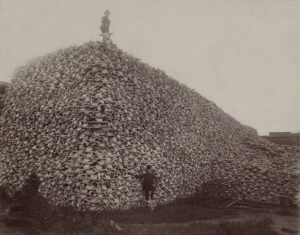
Pile of American bison skulls awaiting grinding for fertilizer, Michigan Carbon Works, Rougeville, Michigan, ca. 1892. Burton Historical Collection, Detroit Public Library. Public domain.
Killing the Buffalo
The Plains Nations lived in relation with the buffalo. The animal was food, clothing, shelter, tools, and spiritual center — a relationship non-Natives rarely understood and often mocked. Historian Andrew Isenberg (2000) has documented that U.S. military strategy recognized exactly what the buffalo meant: destroy the herds, and you destroy the people who depended on them, without having to fight them one by one. An estimated 30 million bison lived on the southern and central plains in 1800; by the mid-1880s, only a few hundred wild bison remained anywhere in the United States (Isenberg, 2000).
The killing was industrial. Commercial hide hunters, supplied with new long-range Sharps rifles and supported by an expanding railroad network, stripped hides, left carcasses to rot, and shipped bones east to be ground into fertilizer (Isenberg, 2000). A Kiowa oral tradition recorded by the storyteller Old Lady Horse captured the meaning of the loss:
“Everything the Kiowas had came from the buffalo … The buffalo saw that their day was over. They could protect their people no longer.” — Old Lady Horse, as cited in Dunbar-Ortiz, 2014, p. 143
Sitting Bull and the Last Wars of Resistance
Sitting Bull (Tatanka Iyotake, 1831–1890) was a young warrior when the first Fort Laramie Treaty (1851) recognized Lakota sovereignty over much of the northern Great Plains. He lived long enough to see that treaty, the second Fort Laramie Treaty (1868), and every other agreement with the U.S. government broken (Utley, 1993). The Bozeman Trail, cut through Lakota territory in the mid-1860s to reach gold fields in Montana, provoked what is sometimes called Red Cloud’s War (1866–1868). Lakota, Cheyenne, and Arapaho forces — fighting under leaders including Sitting Bull, Red Cloud, and Crazy Horse — outmaneuvered the army repeatedly. At the Fetterman Fight in December 1866, the Indigenous alliance annihilated a detachment of 80 U.S. soldiers lured out of Fort Phil Kearny — a defeat remembered in U.S. historiography, tellingly, as the “Fetterman Massacre.”
The 1868 treaty that ended the war recognized Lakota sovereignty over the Black Hills. Sitting Bull refused to sign it (Utley, 1993). When gold was discovered in the Black Hills in 1874, white prospectors poured in, and the United States broke the treaty without ceremony. Custer was sent to force the Lakota and their allies back onto reservations. On June 25–26, 1876, at the Battle of the Little Bighorn, Sitting Bull and Crazy Horse led a combined Lakota, Cheyenne, and Arapaho force that destroyed Custer and five companies of the Seventh Cavalry. It was the greatest Indigenous military victory of the century (Ostler, 2010).
It was also the beginning of the end. The U.S. Army poured resources into the northern plains. The bison campaign intensified. By 1881, with his people starving, Sitting Bull surrendered and was eventually confined to the Standing Rock reservation. He was killed there by Indian Police working for the U.S. Bureau of Indian Affairs on December 15, 1890 — a deliberate choice of executioners designed to make the killing look like an internal matter rather than a federal assassination (Utley, 1993).
Wounded Knee, 1890
Two weeks after Sitting Bull’s death, what remained of Lakota armed resistance ended at Wounded Knee Creek on December 29, 1890. A band of about 350 Lakota, mostly Miniconjou led by Spotted Elk (sometimes called Big Foot), had left the Cheyenne River reservation hoping to reach Pine Ridge. They were hungry, cold, and sick — Spotted Elk himself was dying of pneumonia. The Seventh Cavalry — Custer’s old regiment — intercepted them and camped around them overnight with four Hotchkiss rapid-fire cannons trained on the camp (Ostler, 2004).
What happened at dawn is disputed in detail but clear in outcome. During a weapons search, a single rifle discharged — whether by accident or by a deaf Lakota man named Black Coyote who did not understand the order — and the troops opened fire. The Hotchkiss guns shelled the camp. Soldiers pursued fleeing women and children for miles. Between 250 and 300 Lakota were killed; roughly half were women and children (Ostler, 2004). Twenty U.S. soldiers were later awarded the Medal of Honor for their role in the massacre — a distinction Native activists and some members of Congress have spent more than a century trying to revoke.
Decades later, the Lakota holy man Black Elk, who had been at Wounded Knee as a young man, reflected on what the massacre meant to him in a series of interviews with the poet John Neihardt:
“I did not know then how much was ended … A people’s dream died there. It was a beautiful dream … The nation’s hoop is broken and scattered. There is no center any longer, and the sacred tree is dead.” — Black Elk, as told to Neihardt, 1932/2014, p. 270
Colonial Soldiers
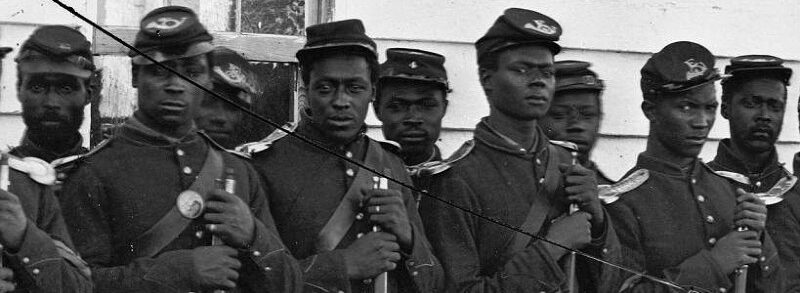
The army that fought these wars after 1865 was not what it had been. Demobilized white officers, newly arrived European immigrants, and — crucially — Black soldiers filled its ranks. Congress created two all-Black cavalry regiments in 1866, the Ninth and Tenth Cavalries, soon joined by two infantry regiments. The Plains nations called them “buffalo soldiers,” apparently in reference to their hair or their fighting endurance; the name stuck. Roughly 20 percent of cavalrymen in the western army during these decades were Black (Leckie & Leckie, 2003).
The presence of buffalo soldiers in these campaigns raises hard questions that historians and Native and Black communities continue to debate. Formerly enslaved men, denied full citizenship in the country they were fighting for, were being used to dispossess another marginalized people. Dunbar-Ortiz (2014) argues that this established a lasting pattern: acceptance into the American national fabric often requires “punching down” against someone else. The army also recruited Native men — the Indian Police, Indian Scouts, and in Sitting Bull’s case, the men sent to arrest and ultimately kill him (Utley, 1993). The logic was cynical and effective: making marginalized groups enforce their own marginalization.
Destroying Indian Identity
Military defeat was followed by an organized assault on Indigenous collective life. By the 1890s, most Native peoples west of the Mississippi had been confined to reservations — often on arid, marginal land far from traditional hunting and farming grounds. Reservations were functionally concentration camps, dependent on federal rations that were often delayed, inadequate, or stolen by corrupt agents (Ostler, 2004).
The Dawes Act, 1887
The General Allotment Act of 1887, commonly called the Dawes Act, attacked the foundation of Native life: communal ownership of land. The Act broke up reservations into individual 160-acre allotments assigned to heads of household and opened any remaining “surplus” to white settlement. Historian Rose Stremlau (2011), studying the Cherokee Nation, has shown that allotment was explicitly intended to dissolve Indigenous kinship networks, not just to transfer land. Between 1887 and 1934, Native peoples lost roughly two-thirds of their remaining land base — approximately 90 million acres (Stremlau, 2011). In 1907, Indian Territory was dissolved entirely and absorbed into the new state of Oklahoma.
Boarding Schools
The final instrument of assimilation targeted children. Beginning with the Carlisle Indian Industrial School (founded 1879 in Pennsylvania), the federal government and missionary organizations built a network of boarding schools whose explicit goal was to “kill the Indian in him, and save the man,” in the words of Carlisle’s founder, Richard Henry Pratt. Children as young as five were taken — often by force or coercion — from their families, given English names, forbidden to speak their languages, beaten for practicing their religions, and trained in manual labor rather than academic subjects (Adams, 1995). “Before and after” photographs, in which children were posed first in traditional dress and then in military-style uniforms, were circulated widely to show what “civilization” looked like.
Historian David Wallace Adams (1995), whose Education for Extinction remains the definitive study of the system, documented widespread physical abuse, sexual abuse, disease, and unmarked graves. A 2022 U.S. Department of the Interior investigation, the first federal accounting of the system, identified more than 400 federally funded boarding schools operating between 1819 and 1969 and began the work of counting the dead (U.S. Department of the Interior, 2022). The schools produced what one scholar called “aliens to both cultures” — children stripped of their own traditions but never granted full standing in the society demanding their assimilation.
The Ghost Dance
In the late 1880s, a Paiute prophet named Wovoka had a vision. The dead would return. The buffalo would return. The earth would be made new, and the settlers would be swept away. Followers danced in circles for days, sometimes falling into trances. The movement spread across the Plains and the Great Basin — not as an army, but as a collective act of spiritual insistence that the world the U.S. had built was not final. Historian Gregory Smoak (2006) has argued that the Ghost Dance is best understood not as a desperate apocalyptic outburst but as an Indigenous political and religious movement that articulated a coherent Native identity in opposition to U.S. colonization.
White officials understood it, correctly, as a political movement and, incorrectly, as a military threat. The fear that the Lakota Ghost Dance might spark an uprising was the pretext for the orders that brought the Seventh Cavalry to Wounded Knee Creek. The dance had no weapons. The army’s response did (Ostler, 2004).
Survival and Red Power
Native nations did not disappear. Federal officials expected them to — nineteenth-century policy was built on the assumption that the “vanishing Indian” was a demographic inevitability — but the opposite happened. Native populations, which had reached a low point of perhaps 250,000 in the United States by 1900, began to recover in the twentieth century. The rights won in the civil rights era opened new organizing space.
President Eisenhower’s 1950s “termination and relocation” policy was designed to dissolve tribal governments and move Native people into cities. Its unintended effect was to concentrate thousands of young Native adults — from dozens of nations — in urban neighborhoods just as the civil rights, Black Power, and anti-war movements were accelerating. Out of these urban communities came the American Indian Movement (AIM), founded in Minneapolis in 1968, and the broader Red Power movement (Estes, 2019).
In November 1969, Native activists occupied Alcatraz Island, citing an 1868 Lakota treaty provision that allowed reclamation of unused federal land. The occupation lasted 19 months and became a defining event of a global Indigenous rights movement (Johnson, 1996). In 1972 the Trail of Broken Treaties brought activists to Washington, D.C., and led to the occupation of the Bureau of Indian Affairs building. In 1973, AIM activists and Oglala Lakota traditionalists occupied Wounded Knee itself — the same ground — for 71 days, demanding that the U.S. government honor its treaties (Estes, 2019). Two Native people were killed in the siege; two federal agents were wounded. Though the immediate demands were not met, the occupation returned Wounded Knee to national consciousness.
In 2007, after decades of advocacy, the United Nations General Assembly adopted the Declaration on the Rights of Indigenous Peoples (United Nations, 2007). Four countries voted against it: the United States, Canada, Australia, and New Zealand — the four English-speaking settler states most shaped by the same century of conquest this chapter has described. All four have since formally endorsed the Declaration, though in most cases with reservations that fall well short of what Indigenous advocates demanded.
Historian Nick Estes (2019), a citizen of the Lower Brule Sioux Tribe and a co-founder of The Red Nation, has argued that the recent wave of Indigenous-led resistance — from the Dakota Access Pipeline protests at Standing Rock in 2016 to the present — is best understood not as a new movement but as the latest expression of an unbroken tradition of Native resistance reaching back through Wounded Knee, the Little Bighorn, and the Long Walk. The army of the West believed it was fighting the last campaigns of a dying people. It was not. The nations are still here. The treaties are still here, on paper and in the minds of the people they were made with. And the questions raised by Sitting Bull, Black Elk, the children taken to Carlisle, and the water protectors at Standing Rock are still here too — unsettled questions about sovereignty, treaty rights, and at whose expense the United States was built.
Bibliography
Adams, David Wallace. Education for Extinction: American Indians and the Boarding School Experience, 1875–1928. Lawrence: University Press of Kansas, 1995.
Black Elk, as told to John G. Neihardt. Black Elk Speaks: Being the Life Story of a Holy Man of the Oglala Sioux. New York: William Morrow & Company, 1932. Complete edition edited by Philip J. Deloria. Lincoln: University of Nebraska Press, 2014.
Chang, David A. The Color of the Land: Race, Nation, and the Politics of Landownership in Oklahoma, 1832–1929. Chapel Hill: University of North Carolina Press, 2010.
Denetdale, Jennifer Nez. Reclaiming Diné History: The Legacies of Navajo Chief Manuelito and Juanita. Tucson: University of Arizona Press, 2007.
Dunbar-Ortiz, Roxanne. An Indigenous Peoples’ History of the United States. Boston: Beacon Press, 2014.
Edwards, Rebecca, Jacob K. Friefeld, and Rebecca S. Wingo. Homesteading the Plains: Toward a New History. Lincoln: University of Nebraska Press, 2017.
Estes, Nick. Our History Is the Future: Standing Rock Versus the Dakota Access Pipeline, and the Long Tradition of Indigenous Resistance. New York: Verso, 2019.
Isenberg, Andrew C. The Destruction of the Bison: An Environmental History, 1750–1920. Cambridge: Cambridge University Press, 2000.
Johnson, Troy R. The Occupation of Alcatraz Island: Indian Self-Determination and the Rise of Indian Activism. Urbana: University of Illinois Press, 1996.
Kelman, Ari. A Misplaced Massacre: Struggling over the Memory of Sand Creek. Cambridge, MA: Harvard University Press, 2013.
Leckie, William H., and Shirley A. Leckie. The Buffalo Soldiers: A Narrative of the Black Cavalry in the West. Rev. ed. Norman: University of Oklahoma Press, 2003.
Ostler, Jeffrey. The Plains Sioux and U.S. Colonialism from Lewis and Clark to Wounded Knee. Cambridge: Cambridge University Press, 2004.
Ostler, Jeffrey. The Lakotas and the Black Hills: The Struggle for Sacred Ground. New York: Viking, 2010.
Smoak, Gregory E. Ghost Dances and Identity: Prophetic Religion and American Indian Ethnogenesis in the Nineteenth Century. Berkeley: University of California Press, 2006.
Stremlau, Rose. Sustaining the Cherokee Family: Kinship and the Allotment of an Indigenous Nation. Chapel Hill: University of North Carolina Press, 2011.
U.S. Department of the Interior. Federal Indian Boarding School Initiative Investigative Report. Washington, DC: Bureau of Indian Affairs, 2022.
United Nations. Declaration on the Rights of Indigenous Peoples (Resolution 61/295). New York: United Nations General Assembly, 2007.
Utley, Robert M. The Lance and the Shield: The Life and Times of Sitting Bull. New York: Henry Holt, 1993.

This entry is licensed under a Creative Commons Attribution-NonCommercial-ShareAlike 4.0 International license.

